 NextTrade Broker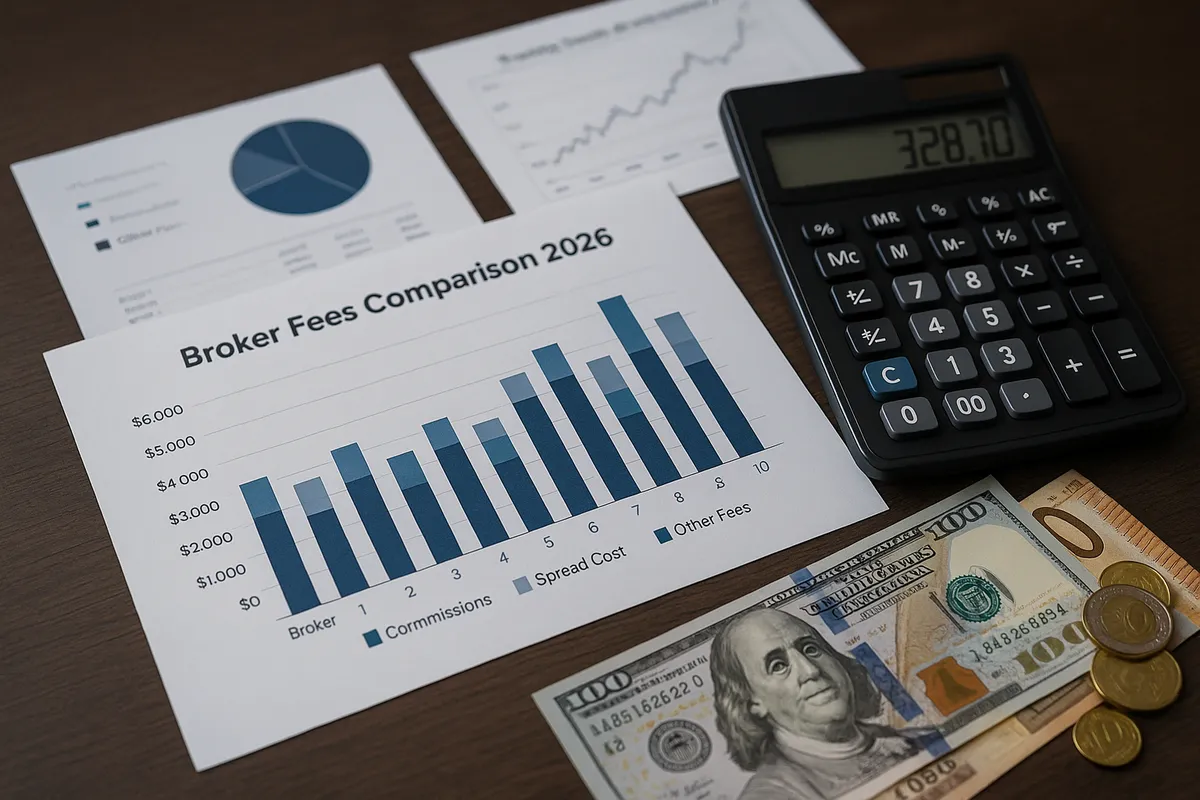

Last updated
Last updated
Based on typical trading patterns, trading fees can eat away 15-20% of your profits each year if you pick the wrong broker. The difference between high-cost and low-cost brokers adds up to thousands of dollars for Active Traders.
broker fees come in many forms. Some charge commissions per trade. Others make money from spreads. Many add Hidden Costs through poor execution or currency conversion fees.
Smart traders compare the total cost of trading, not just the headline numbers. A broker with "zero commissions" might cost more than one with transparent per-trade fees.

Modern brokers use three main fee models. Commission-based brokers charge a fixed fee per trade but offer tighter spreads. Spread-based brokers claim zero commissions but widen the bid-ask spread. Hybrid models combine both approaches.
The key question isn't which model costs less. It's which model costs less for your specific trading style and volume.
Commission-based brokers charge a fixed fee per trade, typically $3-10 for stocks or $0.50-2.00 per forex lot. You see exactly what you pay upfront. The spread stays close to the interbank rate.
Interactive Brokers leads this model with $1 minimum commissions for stocks and $2.50 per forex lot. Their spreads on EUR/USD average 0.1-0.2 pips during London hours.
| Broker Type | Commission Structure | Typical Spread | Best For |
|---|---|---|---|
| Commission-Based | $1-10 per trade | Tight (interbank +0.1) | High volume traders |
| Spread-Based | Zero commission | Wide (interbank +0.5-2) | Casual traders |
| Hybrid | $0.50-3 per trade | Medium (interbank +0.3) | Medium volume traders |
Spread-based brokers make money by widening the gap between buy and sell prices. Instead of charging $5 per trade, they might add 1-2 pips to each side of the spread. This costs nothing upfront but adds up with each position.
Pepperstone and IC Markets use spread-based models for retail accounts. Their EUR/USD spreads range from 0.6-1.2 pips during peak hours. For a standard lot trade, that's $6-12 in hidden costs compared to interbank rates.
The math changes based on your holding period. Day traders who close positions within hours prefer tight spreads over commissions. Swing traders who hold for days often save money with commission models.
Headline fees tell only part of the story. Smart traders dig deeper to find the real cost of trading. Several hidden charges can double or triple your actual trading expenses.
Inactivity fees hit accounts that don't trade regularly. Charles Schwab charges $25 per quarter for accounts under $10,000 with no activity. Fidelity waives these fees but requires $2,500 minimum balances.
Overnight financing costs compound for positions held longer than one day. Based on typical market conditions, Forex Brokers charge swap rates that can reach 3-7% annually. A $10,000 position might cost $300-700 per year in financing.

Poor execution quality creates invisible costs through slippage. Your order gets filled at worse prices than expected. Industry estimates suggest retail traders lose 0.1-0.5% per trade from poor execution at some brokers.
Data fees add another expense layer. Real-time market data costs $10-50 per month at most brokers. options chains and level 2 data can push monthly fees above $100. often miss these recurring costs in their calculations.
Trading Platforms come with their own fee structures. professional platforms like MetaTrader 5 or TradingView Pro cost $15-50 monthly. Advanced features like backtesting or automated trading add extra charges.
TD Ameritrade charges $99.99 monthly for its professional platform unless you trade 36+ times per quarter. E*TRADE's Power E*TRADE Pro is free but requires $250,000 minimum balance or 30 trades quarterly.
Platform fees can exceed $600 annually for active traders, making them a significant cost factor that many overlook when comparing brokers.
API access for algorithmic trading ranges from free to $500+ monthly. interactive brokers offers free API access but limits market data. Other brokers charge based on message volume or connection types.
Mobile app features often require premium subscriptions. Advanced charting, alerts, and research tools cost extra at most brokers. Robinhood Gold costs $5 monthly for margin and extended hours trading.
Third-party integrations add complexity to fee calculations. Tax reporting software, portfolio analytics, and trading journals often require separate subscriptions. These tools cost $10-100 monthly but prove essential for Serious Traders.
Minimum deposit requirements vary dramatically across brokers. Robinhood requires no minimum while interactive brokers demands $10,000 for most accounts. Higher minimums often come with better pricing and features.
Maintenance fees punish small accounts at traditional brokers. Merrill Edge charges $6.95 per trade plus $25 quarterly fees for accounts under $20,000. These fees can consume profits quickly for new traders.
Margin requirements increase costs for leveraged trading. Pattern day trading rules require $25,000 minimum equity for frequent day traders according to SEC regulations. Violations trigger account restrictions or forced closures.
Wire transfer fees range from $15-50 for domestic transfers and $40-80 for international wires. ACH transfers are usually free but take 2-5 business days. Check deposits might face holds or processing fees.
Account closure fees catch traders off guard when switching brokers. Some charge $50-100 to transfer positions to another firm. Full account closure might trigger additional processing costs or require certified mail.
Geographic location affects broker availability and pricing structures. US residents access different brokers than EU or Asian traders. regulations vary significantly across regions.
European brokers face ESMA leverage restrictions limiting forex trading to 30:1 for major pairs. This regulatory constraint affects pricing models and available products. UK brokers operate under FCA rules that differ from EU MiFID II requirements.
Australian brokers under ASIC oversight offer higher leverage but face stricter capital requirements. Japanese brokers limit forex leverage to 25:1 for retail traders. These rules directly impact broker fee structures and account minimums.
| Region | Max Leverage | Typical Commission | Regulatory Protection |
|---|---|---|---|
| United States | 50:1 forex, 2:1 stocks | $0-10 per trade | SIPC $500k |
| European Union | 30:1 forex, 5:1 stocks | $2-15 per trade | €20k-90k varies by country |
| United Kingdom | 30:1 forex, 5:1 stocks | $1-8 per trade | FSCS £85k |
| Australia | 500:1 forex, 5:1 stocks | $3-12 per trade | ASIC varies |
currency conversion adds extra complexity for international traders. USD-based accounts might face conversion fees when trading European stocks. Multi-currency accounts reduce these costs but complicate tax reporting.
Tax treatment varies by jurisdiction. US traders benefit from Section 1256 contracts for forex futures. UK spread betting offers tax-free profits for most traders. These differences affect net trading costs significantly.
broker comparison websites offer fee calculators but often miss key cost factors. matters more than saving a few dollars on commissions.
Build your own cost calculator based on actual trading patterns. Track trades for one month including entry/exit times, position sizes, and holding periods. Apply different broker fee structures to this real data.

NerdWallet and Bankrate maintain broker comparison tools that factor in multiple cost elements. Their calculators consider trading frequency, account size, and typical position sizes. However, they don't account for execution quality differences.
StockBrokers.com provides detailed fee breakdowns for over 150 brokers. Their comparison includes platform fees, market data costs, and account minimums. The site updates pricing quarterly but may miss temporary promotions.
Create scenarios for different trading styles. Compare costs for 10 trades monthly versus 100 trades monthly. Factor in account funding methods and withdrawal frequency. Small differences compound over time.
Smart position sizing reduces percentage impact of fixed commissions. Trading larger positions less frequently often costs less than many small trades. A $10 commission on a $10,000 trade costs 0.1% versus 1% on a $1,000 trade.
Timing trades during peak market hours reduces spreads and improves execution. EUR/USD spreads tighten to 0.1-0.3 pips during London/New York overlap. Off-hours trading can double or triple spread costs.
choose appropriate order types to minimize market impact. Limit orders avoid slippage but risk missing fills. Market orders guarantee execution but may face wider spreads during volatile periods.
Fund accounts efficiently to avoid conversion fees. Use same-currency funding when possible. Some brokers offer better exchange rates for larger deposits or premium account holders.
Monitor promotional rates and fee waivers. New brokers often offer zero commissions or reduced fees for the first 90 days. Established brokers run periodic promotions for high-volume traders.
Negotiate fees based on trading volume. Brokers often reduce commissions for traders who generate consistent revenue. Document your trading activity and request lower rates after establishing a track record.
Excessive account maintenance fees signal outdated business models. Monthly fees above $10-15 for basic accounts suggest the broker profits from inactive clients rather than trading activity.
Withdrawal restrictions or high exit fees trap your money with unsuitable brokers. Some charge $50+ for wire transfers or limit withdrawals to once monthly. These practices indicate cash flow problems or predatory business models.
Unusually wide spreads during news events reveal poor liquidity sourcing. Professional brokers maintain tight spreads even during volatility. Spreads that widen beyond 3-5 pips during news suggest dealing desk manipulation.
Complex tiered pricing structures hide true costs from casual analysis. Brokers with 5+ pricing tiers based on volume, account size, or asset class make Cost Comparison nearly impossible.
Forced account upgrades or feature restrictions pressure traders into higher-cost plans. Legitimate brokers offer clear pricing without artificial limitations designed to generate upgrade revenue.
Focus on commission per trade, spread markups, overnight financing costs, and currency conversion fees. Based on typical trading analysis, these four categories represent 80-90% of total trading costs for most traders. Account maintenance and platform fees matter for specific trading styles but affect fewer people.
Track all trades for one month including entry/exit prices, position sizes, and holding times. Multiply by 12 for annual estimates. Add fixed costs like platform fees, data subscriptions, and account maintenance charges. Include currency conversion and funding costs if applicable.
No broker operates for free. Zero-commission brokers make money through spread markups, payment for order flow, margin lending, or premium service fees. Compare total trading costs including spreads and hidden fees, not just headline commission rates.
Commission models typically cost less for high-volume traders, swing traders holding positions for days, and traders using limit orders in liquid markets. Day traders making many small trades often prefer spread-based pricing to avoid per-trade charges.
Currency conversion fees (0.25-2%), inactivity charges ($10-50 quarterly), withdrawal fees ($15-80), platform subscription costs ($15-100 monthly), and poor execution quality causing slippage (0.1-0.5% per trade). These costs often exceed headline commission rates.
Review fees annually or when your trading style changes significantly. New brokers enter the market regularly with competitive pricing. Existing brokers adjust fee structures quarterly. Major trading volume increases may qualify you for better pricing tiers.
Smart fee comparison requires looking beyond headline numbers to understand total trading costs. The cheapest advertised rates rarely represent the actual cost of active trading when you factor in all expenses.
Take time to calculate real costs based on your specific trading patterns. A few hours of analysis can save thousands of dollars annually in unnecessary fees and poor execution quality.
Remember that the lowest-cost broker isn't always the best choice. Factor in execution quality, platform reliability, customer service, and regulatory protection when making your final decision. Your money's safety matters more than saving a few dollars on commissions.

Forex Market Research Analyst
David Kim brings 15 years of institutional forex analysis experience to retail and prop trading evaluation. His data-driven approach to broker comparison and market structure analysis provides traders with the quantitative insights needed for informed platform and strategy decisions.